
- Your cart is empty
- Continue Shopping


CGM vs. Regular Glucometer: Understanding the Difference
- Blog
- Posted on
-
by Muneeb Rehman
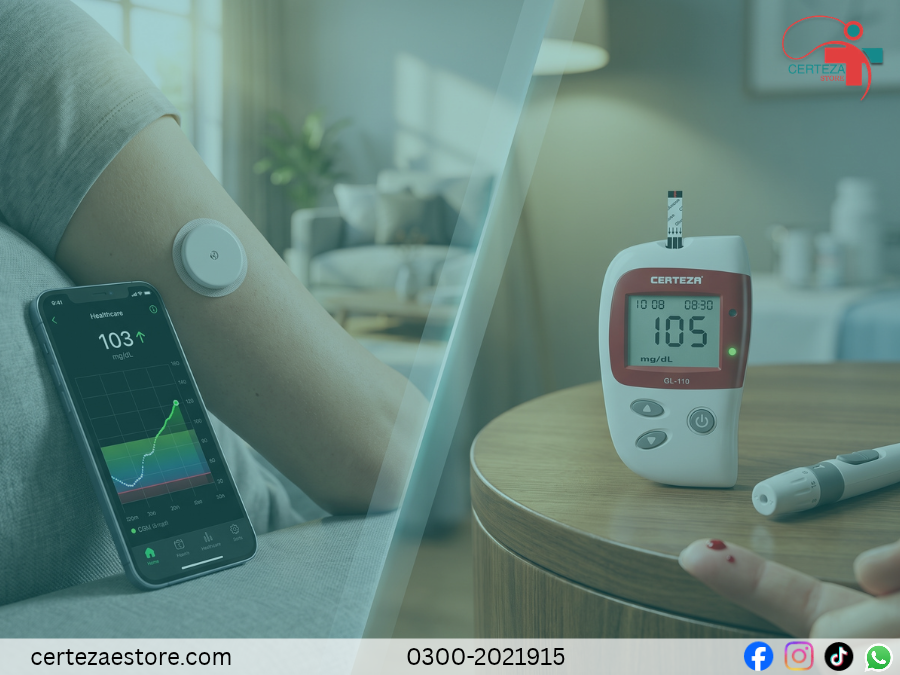
Managing glucose levels whether for diabetes management, pre-diabetes care, or clinical learning often comes down to choosing the right monitoring tool. Many patients transition from standard finger-prick blood glucose meters to Continuous Glucose Monitors (CGMs), only to be confused when the two devices display different numbers at the same moment.
If you have ever wondered why these numbers do not align, or which device best fits your daily routine, this guide breaks down the biological mechanisms, key differences, and practical uses of both devices.
What Are These Devices?
Regular Blood Glucose Meter (BGM)
A traditional Regular Glucometer is a point-in-time testing tool. You prick your fingertip with a lancet, place a drop of blood onto a disposable test strip, and the meter reads your exact capillary blood glucose level at that single instant.
Continuous Glucose Monitor (CGM)
A Continuous Glucose Monitor (CGM) is a wearable sensor applied to the skin (usually on the back of the upper arm or abdomen). It utilizes a tiny micro-filament inserted just under the skin to automatically measure glucose levels every few minutes, transmitting real-time data and trend graphs to a smartphone or dedicated receiver.
The Analogy
To understand how these tools differ, imagine observing traffic on a highway:
- A Regular Glucometer is like taking a single photograph. It shows you exactly how many cars are on the road at 8:00 AM. However, it cannot reveal whether traffic was backed up five minutes ago or if a traffic jam is forming ahead.
- A CGM is like streaming a live video feed. It records continuous movement, allowing you to see traffic flow in real time, spot patterns over hours, and anticipate traffic buildup before it happens.
Key Takeaway: A finger prick tells you where you are, while a CGM tells you where you are heading.
How They Work: The Science Behind the Numbers
The key to understanding both devices lies in where they measure glucose in your body.
[ Food Consumed ] ➔ [ Absorbed into Bloodstream ] ➔ [ Diffuses into Interstitial Fluid ] │ │ (Regular Meter Reads Here) (CGM Reads Here)
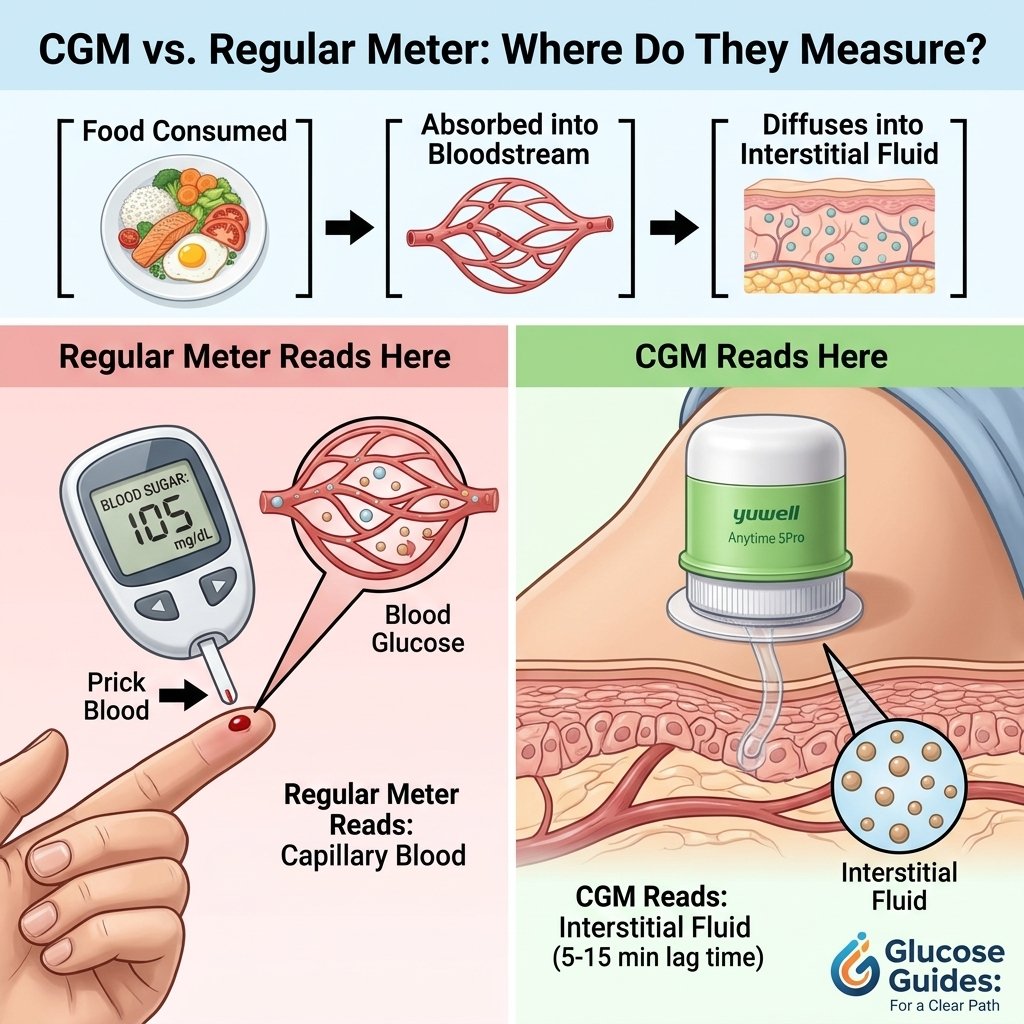
- Glucose enters the bloodstream first: When you eat carbohydrates, your body breaks them down into glucose, which enters your blood vessels. A traditional finger prick tests capillary blood, giving an immediate reflection of blood sugar.
- Glucose moves into tissue fluid: Next, glucose trickles out of the tiny capillaries and fills the spaces around your cells. This fluid is called interstitial fluid.
- The 5–15 Minute Lag Time: Because it takes time for glucose to transfer from the blood into the interstitial fluid, the CGM reading trails behind capillary blood readings by 5 to 15 minutes.
When your glucose levels are stable (e.g., fasting before breakfast), blood and tissue fluid glucose levels match closely. However, right after meals, exercise, or insulin administration, blood glucose changes rapidly, while interstitial fluid glucose takes time to catch up.
Comparison Table: CGM vs. Regular Glucometer
| Feature | Regular Glucometer (BGM) | Continuous Glucose Monitor (CGM) |
| Measurement Source | Capillary Blood | Interstitial Fluid |
| Reading Frequency | On-demand (Instant snapshot) | Continuous (Every 1–5 minutes, 24/7) |
| Measurement Lag | None (Immediate real-time blood level) | 5 to 15-minute physiological lag |
| Trend Visibility | Single number only | Numbers + Directional Trend Arrows + Historical Graphs |
| Physical Pain / Intrusion | Multiple finger pricks daily | Single sensor insertion every 10–14 days |
| Hypoglycemia Alerts | None (Only detected when actively testing) | Built-in custom alarms for rapid drops or low sugar |
| Primary Advantage | Highly accessible, lower upfront cost, instant baseline | Identifies overnight spikes/lows, reduces finger pricks |
Common Misunderstandings & Myths
Myth 1: “My CGM is inaccurate because it doesn’t match my finger-prick meter.”
The Reality: They are sampling two different biological fluid compartments. If your blood sugar is changing rapidly such as 30 minutes after eating your blood sugar has already risen, but your interstitial fluid level is still catching up. The difference reflects physiological transfer time rather than device failure.
SAFETY WARNING: When to Trust the Finger Prick If your CGM displays a normal reading but you experience physical symptoms of low blood sugar (such as shakiness, sweating, confusion, or dizziness), always perform a finger-prick test. Capillary blood reflects rapid drops immediately, making finger-prick meters the primary standard for verifying acute hypoglycemia.
Myth 2: “Using a CGM means I never have to prick my finger again.”
The Reality: While CGMs significantly reduce finger pricks, traditional meters remain essential. You still need finger-prick tests to:
- Calibrate certain CGM models (if required by the manufacturer).
- Confirm rapid glucose changes before making critical insulin dosing decisions.
- Double-check sensor readings if you suspect the sensor has failed or dislodged.
Real-Life Applications: When to Use Which Tool
1. Post-Meal Spikes (Understanding Diet Impact)
- Standard Meter: Checking blood sugar 2 hours after a meal gives a single data point.
- CGM: Reveals the entire curve showing exactly when the spike peaked (e.g., at 45 minutes) and how quickly your body returned to baseline.
2. During Exercise
- Standard Meter: Shows your current level, but requires stopping your workout to test.
- CGM: Trend arrows show whether sugar is declining steadily or crashing rapidly, allowing you to consume fast-acting carbohydrates before a low occurs.
3. Overnight Monitoring
- Standard Meter: Cannot track glucose levels while you sleep unless you wake up to test.
- CGM: Tracks overnight trends continuously and sounds audible alarms if glucose drops to dangerous levels while sleeping.
The Memorable Takeaway
A regular glucometer gives you an immediate blood sugar snapshot; a CGM shows you the continuous glucose direction. Use finger pricks to verify current blood levels, and use a CGM to track trends and prevent high and low spikes before they happen.
Conclusion
Choosing between a regular glucometer and a Continuous Glucose Monitor (CGM) depends on your daily health needs. A standard finger-prick meter gives you an instant blood sugar snapshot, while an advanced continuous glucose sensor like the Yuwell Anytime 5Pro CGM provides 24/7 trend tracking and real-time alerts.
For buying genuine medical devices and authentic glucose monitors online in Pakistan, Certeza Store is the most trusted platform. You can easily order 100% original CGMs, glucometers, and diabetes care products from Certeza Store with fast doorstep delivery across Pakistan.
